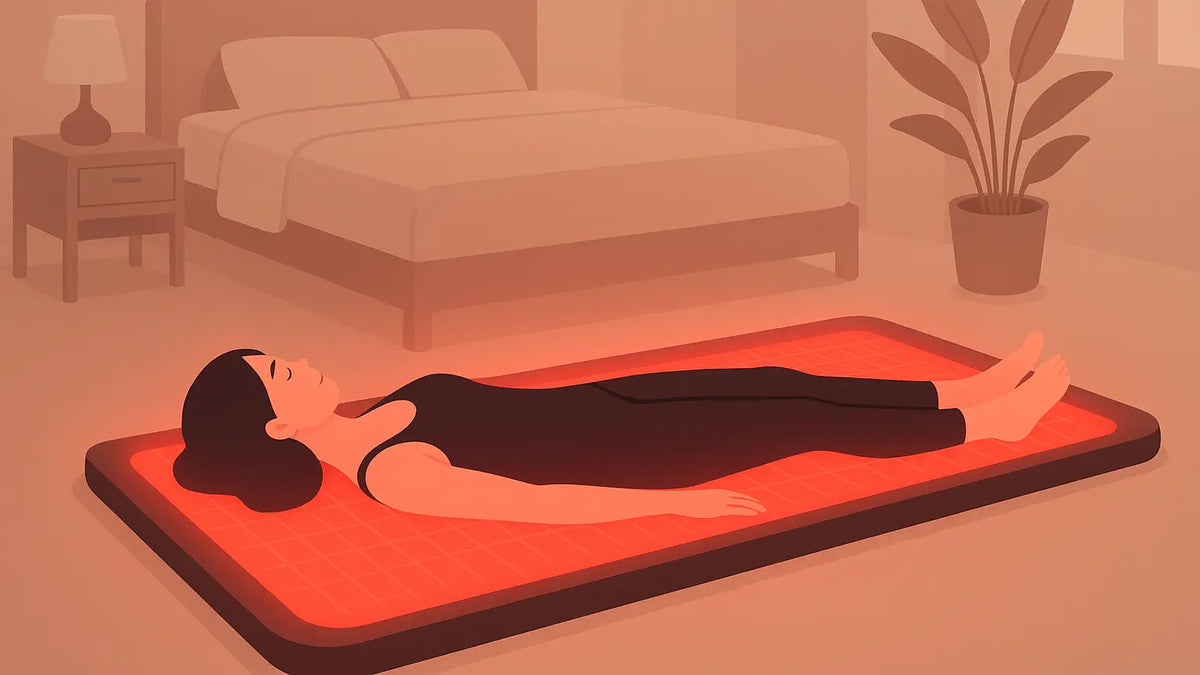
Red light therapy mats are having a moment—and for understandable reasons. The idea is simple: lie down, let red and near‑infrared light shine on your body, and (over time) support things like skin health, comfort, and recovery.
This guide walks you through the benefits people use red light therapy mats for, what the evidence suggests, and how to use a mat safely—without medical promises.

What is a red light therapy mat?
A red light therapy mat is a flat, flexible device (often full-body sized) that uses LEDs to emit red and sometimes near‑infrared (NIR) light. You typically lie on it (or place it on a body area) for short sessions, several times per week.
This approach is part of a broader category often called red light therapy or photobiomodulation—terms you’ll see used in clinical settings as well as consumer wellness products.
Red light vs near‑infrared: the quick difference
- Red light is visible (it looks red).
- Near‑infrared light is mostly invisible, but you may still feel warmth depending on device power.
Many at‑home mats include both, because they’re often marketed for “skin + deeper tissue” use. You don’t need to memorize the physics; just know that devices can vary a lot, and the “dose” matters.
Mat vs panel vs mask: which format fits what you want?
If you’re new to this, you’ll run into a basic choice: mat, panel, or mask (plus smaller handheld devices).
Here’s a practical comparison to help you think clearly:
|
Device format |
Best for |
Watch for |
Why it matters |
|---|---|---|---|
|
Mat |
Full-body convenience, relaxing routines, large-area exposure |
Some mats can be lower intensity or have uneven contact; easy to overdo time because it feels passive |
Great for consistency—if you’ll actually use it |
|
Panel |
Targeting specific areas (back, knees, face), more control over distance |
Brightness/eye safety; needs setup space; you have to position yourself |
Distance changes intensity a lot |
|
Mask |
Face-focused skincare routines |
Fit, comfort, eye cutouts, device quality |
Useful when your goal is mostly facial skin |
If your goal is “I want something I can actually stick with,” mats often win on habit. If your goal is “I want precision,” panels may be easier to control.
Red light therapy mat benefits: what people use mats for
Let’s be honest: people buy mats because they want results—better skin, less discomfort, faster recovery, better sleep.
The key is to treat benefits in tiers:
- Best-supported (for consumer claims): studied more consistently and discussed by reputable medical organizations.
- Mixed evidence: may help for certain people or protocols, but not a slam dunk.
- Early evidence / mostly anecdotal: interesting, but easy to overhype.

1) Skin appearance: texture, fine lines, and redness
Red light therapy is widely used in dermatology-adjacent contexts for photoaging and general skin appearance. The American Academy of Dermatology notes that research suggests red-light LED devices can lead to improvements in things like fine lines and wrinkles, discoloration, rough texture, and redness—while also emphasizing that studies vary and results can be subtle or gradual.
Harvard Health also describes red light therapy as a noninvasive option that may support collagen-related improvements over time and stresses that consistency matters more than one intense session.
What to expect (realistically):
- Think “gradual improvement,” not “overnight transformation.”
- Results depend on device quality, your baseline skin condition, and how consistently you use it.
2) Everyday comfort: soreness and inflammation-related aches
Many people use red/NIR light devices for muscle and joint comfort, especially after workouts or during periods of stiffness.
Consumer medical explainers commonly list pain and inflammation as potential use cases, but they also tend to emphasize variability.
A cautious way to interpret this:
- It may be a helpful supporting tool for comfort and recovery routines.
- It shouldn’t replace medical evaluation for persistent pain, swelling, numbness, or unexplained symptoms.
3) Recovery routines: a “stackable” tool
The most common real-world use case is simple: people use a mat to feel better after training.
This is where mats can shine—not because they’re magic, but because they make a recovery routine easier to repeat.
If you want to test this benefit honestly, set a baseline:
- Pick one training pattern (e.g., 3 strength sessions/week).
- Use the mat consistently for 4–6 weeks.
- Track 2–3 signals: perceived soreness the next day, sleep quality, and whether you feel ready for your next session.
That won’t “prove” a mechanism, but it will tell you whether it’s worth your time.
4) Sleep and wind-down: plausible, but easy to overstate
Some people report that red light sessions help them wind down, especially when used as a pre-sleep routine (dim lights, no phone, lie down for 10–20 minutes).
There’s a simple reason this can feel helpful even without strong claims: you’re building a consistent relaxation cue.
If you try it:
- Keep sessions earlier in the evening if the device is bright.
- Pair it with boring, repeatable habits (same time, same room, same breathing pattern).
If sleep is a major issue for you, it’s worth discussing with a clinician—sleep problems can have many causes.
Red light therapy mat safety: what to watch for
Short-term use is generally described as safe when devices are used as directed, but reputable sources consistently mention a few watch-outs.
Protect your eyes
Even if you’re using a body mat (not a face device), light can scatter in a room.
- Follow your device instructions.
- If the device includes eye protection or recommends it, use it.
Be careful if you’re photosensitive
If you:
- have a condition that increases light sensitivity.
- take medications that increase light sensitivity.
Darker skin tones may need extra caution
The AAD warns that people with darker skin can be more sensitive to visible light and may be at higher risk for hyperpigmentation with stronger or longer exposure. If that describes you, start conservatively and consider professional guidance.
Don’t use it as a substitute for diagnosis
A mat can be a comfort tool. It’s not a diagnostic device.
If you have:
- unexplained pain,
- a new lump,
- worsening swelling,
- concerning skin changes,
…don’t treat it as a DIY project.
Summary
Red light therapy mats offer a convenient, full-body approach to wellness by combining red light for skin health with near-infrared light for deeper tissue support. The primary benefits include rejuvenating skin texture—specifically reducing fine lines and redness—and accelerating physical recovery by easing muscle soreness and joint stiffness. Additionally, incorporating a mat into a nightly routine can serve as a relaxation cue to improve sleep hygiene. While effective as a non-invasive tool for comfort and aesthetics, results are gradual and require consistent use alongside proper safety precautions, such as eye protection and monitoring for skin sensitivity.


