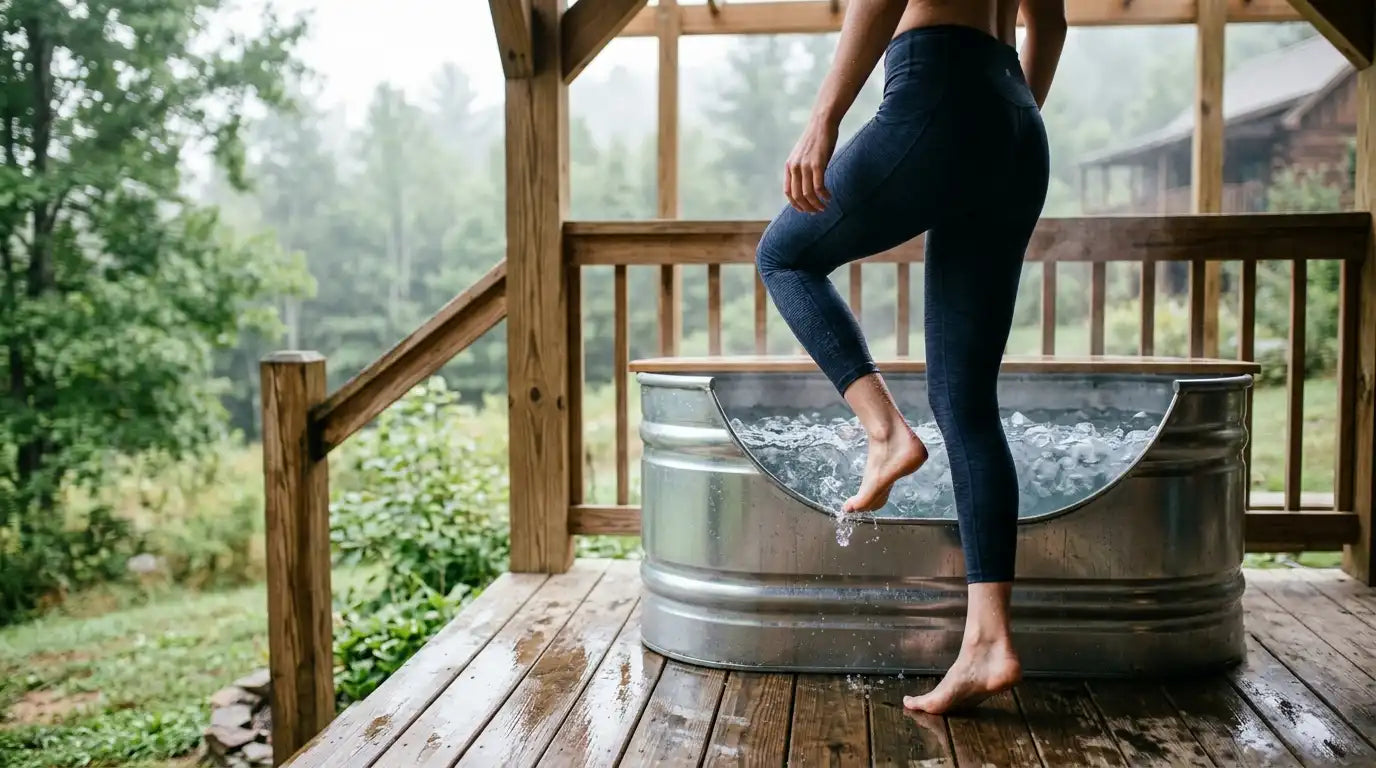
Your bathtub faucet is running cold, and three bags of ice are already sweating onto the kitchen counter. In twenty minutes you're going to lower yourself into water that will make your chest lock up on contact, and you're going to second-guess the whole idea somewhere around minute two.
Doing this at home means full-body immersion in 50–59°F (10–15°C) water for two to ten minutes, using a bathtub, stock tank, or dedicated tub cooled with bagged ice or a water chiller. Beginners should start around 55–60°F for under two minutes, two to three times a week, and check with a doctor first if you have a heart condition, are pregnant, or have Raynaud's. Everything past that point is detail — the sections below cover the detail.

What "Doing This at Home" Actually Means
People use "ice bath," "cold plunge," and "cold shower" like they're the same thing. They're not quite, and the difference matters once you're trying to plan an actual setup.
| Method | Typical Temperature | Body Coverage | Typical Session |
|---|---|---|---|
| Cold shower | 55–70°F (13–21°C) | Partial, one area at a time | 30 sec–3 min |
| Ice bath / cold plunge | 50–59°F (10–15°C) | Full immersion | 2–10 min |
| Whole-body cryotherapy | Down to -166°F (-110°C), dry air | Full body, very brief — needs a commercial chamber | 2–4 min |
A cold shower is the low-friction version — no tub, no ice, no plumbing decisions. An ice bath asks more of you and gives back a bigger physiological response, which is really the whole trade. Cryotherapy isn't a realistic home option at all, so if you've seen it mentioned alongside "ice bath at home," that's usually a comparison article, not something you can replicate in your garage. IceDragon's piece on why people take ice baths in the first place gets into the reasoning behind choosing the harder option on purpose.
What You Need Before You Fill the Tub
The equipment list is shorter than most people expect.
- A container that holds at least 30–40 gallons — your own bathtub, a 100-gallon stock tank from a farm supply store, a heavy plastic tote, or a purpose-built tub
- Ice, and more of it than you'd guess. A standard bathtub filled to around 50°F typically needs 40–60 lb
- A floating pool thermometer — an eight-dollar one works fine
- A timer you can actually see, because your hands won't be steady enough to unlock a phone in the first thirty seconds
- Warm, dry clothes and a towel, staged within reach before you get in, not after
- A non-slip mat if you're stepping onto wet tile or a deck
- Optionally, a lid if you're not draining same-day, and a water chiller if buying ice every session starts to feel like a part-time job
If you're weighing exactly how much ice to buy for your tub size, IceDragon has a full breakdown of ice quantities by tub size that saves a wasted grocery trip.
Ice works. It also repeats every single time you want to plunge, it melts unevenly depending on the season, and it means checking a thermometer instead of just knowing your water is where you left it.
Recommended Products


A chiller removes that part of the equation — you set a target temperature once and the water stays there, whether it's August or January. That convenience is the actual argument for a chiller-equipped tub over a bathtub-and-ice setup; it isn't that ice "doesn't work."
Temperature, Duration, and How Often
Most "how cold, how long, how often" guides converge on a similar range, but the right number for you depends on where you're starting from.
| Experience Level | Water Temperature | Session Length | Frequency |
|---|---|---|---|
| First-timer | 55–60°F (13–15°C) | 30 sec–2 min | 1–2×/week while adapting |
| Regular practice | 50–55°F (10–13°C) | 3–8 min | 2–4×/week |
| Experienced | Below 50°F (<10°C) | Up to 10–15 min | Based on individual tolerance |
The frequency figure isn't arbitrary. One study of experienced winter swimmers linked roughly 11 minutes of total weekly cold-water immersion, spread across two to three sessions, to measurable increases in cold-induced thermogenesis (Søberg et al., Cell Reports Medicine, 2021). That's a useful reference point, but it's worth being honest about what it is: an observation in people who'd already been winter swimming for years, not a clinical minimum dose for someone trying this for the first time. For a longer look at how duration should shift based on your specific goals, IceDragon's guide to how long to stay in an ice bath walks through the variables.
Recommended Products
None of these ranges help much if your actual water temperature and your thermometer reading have drifted apart — which happens more than people expect with a bucket-and-guesswork setup, especially as ice melts over the course of a session.
What a Home Cold-Plunge Setup Actually Costs in 2026
"Ice bath tub" covers a startling amount of ground — from a $79 inflatable pod to a $14,000 stainless steel tub — and the difference isn't purely marketing.
| Setup Type | Example | Approx. Price (USD) | Electricity |
|---|---|---|---|
| Ice-only barrel | Ice Barrel 300/400 | ~$1,199–$1,299 | None |
| Portable tub + entry chiller | IceDragon Portable Cold Plunge Tub + 1/3 HP chiller | $159 tub + $699 chiller | Standard outlet |
| Mid-range chiller tub | IceDragon Tub Ice Bath with 2/3HP Smart Water Chiller | $1,138 | Standard outlet |
| Boutique chiller tub | Plunge / Renu | ~$5,000–$12,000 | Dedicated circuit |
| Premium chiller tub | Sun Home Cold Plunge Pro (316 stainless, ozone/UV filtration) | ~$13,999 | Dedicated circuit |
Prices checked July 2026; IceDragon figures from icedragonclub.com product listings, competitor figures via HomePlunge's Ice Barrel review and the 2026 cold plunge tub roundup distributed via PR Newswire. Confirm current pricing before publishing, since it moves.
The ice-only route wins on simplicity — nothing to wire, nothing to maintain on a schedule — but you're buying and hauling ice indefinitely. HomePlunge's own cost breakdown estimates that adds roughly $1,800 to $2,700 over five years for someone plunging two to three times a week, which is enough to close most of the gap with a chiller purchase. A chiller-equipped tub costs more on day one and removes both the recurring ice cost and the daily guesswork of hitting a target temperature. Where a specific tub lands on this table has more to do with chiller horsepower, tank insulation, and sanitation features — ozone, UV, filtration — than with the brand printed on the side, and a 1/3 HP chiller that's fine in a small indoor tub will struggle to keep pace outdoors in a warm climate, which is part of why the 1 HP and 1.5 HP tiers cost what they do.
Does It Actually Help — Or Get in the Way?
The soreness relief is the best-supported part of this story. A 2012 Cochrane review pooling 17 trials found cold water immersion reduced delayed-onset muscle soreness compared with passive rest, with the effect still measurable several days later (Bleakley et al., Cochrane Database of Systematic Reviews, 2012). That's a real, repeatedly observed effect — though the review's own authors flagged that trial quality was generally low, and cold water immersion didn't clearly beat contrast baths or warm-water immersion, so "cold specifically" is doing less work than the marketing around it usually implies.
The inflammation story is more complicated than most home guides let on. A 2025 review of 11 randomized trials and over 3,000 participants found stress levels dropped meaningfully, but only starting around 12 hours after immersion — and inflammatory markers were actually higher immediately afterward and at the one-hour mark, not lower (Cain et al., PLOS ONE, 2025). In other words, cold water doesn't calm inflammation on contact. It triggers a stress response that resolves into something calmer over the following hours, which is a different mechanism than "reduces inflammation" implies.
Mood and alertness have a real, if narrower, basis than the internet's favorite version of the claim. One frequently cited study measured a roughly four-fold rise in plasma noradrenaline during a one-hour, 14°C head-out immersion (Šrámek et al., European Journal of Applied Physiology, 2000). That protocol is considerably longer and colder than a typical five-minute home session, so treat any specific "your dopamine spikes 250%" figure you see attached to a quick home plunge with some skepticism — the underlying study doesn't quite say that.
If muscle size or strength is the goal, timing matters more than temperature. Roberts and colleagues found cold water immersion performed immediately after resistance training blunted the molecular signaling muscles use to grow, along with smaller strength and mass gains over a 12-week training block compared with active recovery (Roberts et al., Journal of Physiology, 2015). That finding doesn't do this product category any favors, but it's real — and it's why IceDragon's own piece on why ice baths help with muscle recovery doesn't skip past it either. Waiting several hours after a strength session, or moving cold exposure to a rest day, sidesteps the trade-off for most lifters. For the fuller research picture, including where the evidence is still thin, see IceDragon's overview of whether ice baths are good for you.
Who Should Not Try This at Home
A few situations call for a conversation with a doctor before anyone gets near the tub, not after:
- Diagnosed heart disease, arrhythmia, or uncontrolled high blood pressure — the initial cold shock raises heart rate and blood pressure within seconds of entry
- Beta-blockers or other medications that blunt heart-rate response, which can make it harder for the body to adjust to sudden cold
- Pregnancy
- Raynaud's syndrome or another circulation disorder affecting the hands and feet
- Cold-induced asthma, or a history of struggling to control breathing under stress
- Doing this alone for your first few sessions — have someone nearby who can help if something goes wrong
The American Heart Association has reported that sudden immersion in water colder than 60°F can trigger a rapid spike in heart rate and blood pressure severe enough to pose real risk for people with existing cardiac issues, largely within the first moments of entry (American Heart Association, 2022). The reassuring part: repeated, gradual cold exposure has been shown to blunt the intensity of that initial shock response over time (Tipton et al., Experimental Physiology, 2017), which is the physiological reason "start warmer and shorter" isn't just a cautious suggestion — it's how tolerance is actually built. IceDragon is a retailer of cold-therapy and recovery equipment, not a medical provider, and nothing here is a substitute for a conversation with your own doctor if any of the above applies to you.
Your First Session, Step by Step
- Fill the tub about halfway with cold tap water, then add ice gradually while stirring, checking with your thermometer until you're in the 50–59°F range
- Stage a towel and warm, dry clothes somewhere you can reach without leaving the room
- Spend two to three minutes on slow, nasal breathing before getting in — long exhales specifically, since that's what keeps the initial shock response manageable. IceDragon's piece on why athletes take ice baths covers the nervous-system mechanism behind this in more depth
- Step in feet-first on an exhale, and get your shoulders under within the first ten to fifteen seconds rather than lowering yourself in slow motion
- Breathe through the first 30–45 seconds. That's the hardest part, and most people settle into something closer to calm once it passes
- Get out when your timer says so, not when you feel like you could push further — this isn't a tolerance contest
- Dry off and dress warmly right away, then let your body rewarm gradually through light movement rather than a hot shower straight away
Keeping the Water Usable Between Sessions
How often you need to refresh the water depends heavily on your setup. A basic bathtub or an inflatable pod without filtration should generally be drained and refilled every few days to a week with regular use — IceDragon recommends weekly changes for its portable tubs, along with a warm, soapy rinse between fills. Chiller-equipped systems with filtration can typically stretch to two to four weeks between full changes, though local water hardness and how many people share the tub both shift that window. If the water looks cloudy or smells off before your usual schedule, treat that as your signal to change it, not the calendar. If you're comparing chiller options with filtration built in, IceDragon's collection of water chillers for ice baths breaks down cooling capacity by tub size, and the FAQ page covers shipping, assembly, and warranty questions that tend to come up once you're actually ready to buy.
Summary
Setting up an ice bath at home really comes down to three decisions: how you'll get the water cold, how disciplined you'll be about temperature and timing, and how honestly you weigh the research against what gets repeated online. The soreness relief holds up reasonably well across the evidence. The muscle-growth trade-off is real if you lift for size, and worth respecting rather than ignoring. The mood lift has a measurable basis, even if it's smaller and shorter-lived than some of the claims attached to it. None of that requires the most expensive tub on the market. It requires consistency, a working thermometer, and enough respect for cold water to treat the safety guidance as more than fine print.
Further Reading
- Ice Bath vs Sauna: Which Is Better for Muscle Recovery and Performance
- Cold Shower vs Cold Plunge: Which One Is Right for You?
- Ice Bath Before or After Workout?
FAQs
Can I use a regular bathtub as an ice bath, or do I need a special tub?
A standard bathtub works fine for occasional use — you'll just need more ice than a smaller, insulated tub since bathtubs aren't built to hold cold. Expect closer to 40–60 lb of ice per session, and expect the water to creep warmer faster than it would in a dedicated tub.
Is it normal to feel short of breath the first few times?
Yes — that's the cold shock response, which is exactly why breath control matters more than toughness here. If the gasping doesn't ease within the first minute, or you feel chest pain, dizziness, or numbness beyond mild discomfort, get out and don't treat it as something to push through.
Can I do an ice bath every day, or should I take rest days?
Most people tolerate two to four sessions a week without issue, and daily use is common among experienced practitioners chasing the mood and stress-tolerance side of this specifically. If you're also strength training, daily sessions right after lifting are the one combination worth avoiding, since that's where the muscle-growth trade-off shows up.
Do I need to add salt or anything else to the water?
No — plain cold water and ice are enough for the cold-exposure effect itself. Some people add an unscented sanitizer or filtration additive to extend water life between changes, but that's a hygiene choice, not something the physiological effect depends on.
What's the difference between an "ice bath" and a "cold plunge tub" — are they the same thing?
In practice, most people use the terms interchangeably. If there's a distinction worth drawing, "ice bath" usually implies adding ice yourself each session, while "cold plunge tub" more often refers to a dedicated, insulated — sometimes chiller-equipped — tub built for repeated cold water immersion without the ice run.
References & Sources
- Cold-water immersion (cryotherapy) for preventing and treating muscle soreness after exercise – Cochrane Database of Systematic Reviews, 2012
- Effects of cold-water immersion on health and wellbeing: A systematic review and meta-analysis – PLOS ONE, 2025
- Human physiological responses to immersion into water of different temperatures – European Journal of Applied Physiology, 2000
- Post-exercise cold water immersion attenuates acute anabolic signalling and long-term adaptations in muscle to strength training – The Journal of Physiology, 2015
- Altered brown fat thermoregulation and enhanced cold-induced thermogenesis in young, healthy, winter-swimming men – Cell Reports Medicine, 2021
- You're not a polar bear: The plunge into cold water comes with risks – American Heart Association, 2022
- Cold water immersion: kill or cure? – Experimental Physiology, 2017
- The Best Cold Plunge Tubs of 2026: Expert Picks – PR Newswire
- Ice Barrel Review: 7 Key Facts Before You Buy (2026) – HomePlunge


