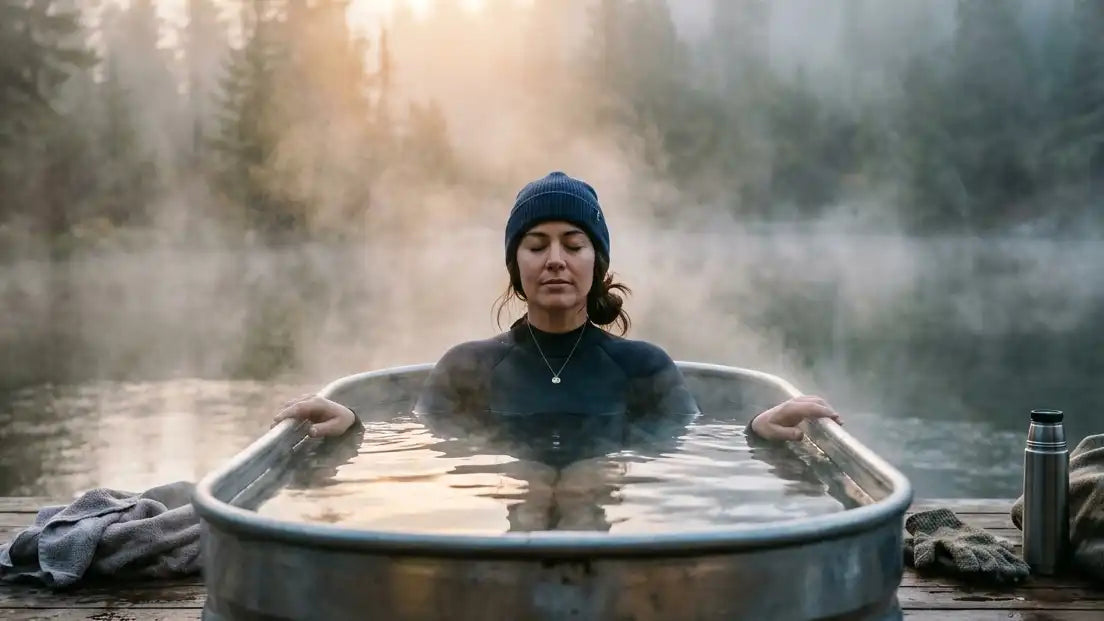
Stand next to a tub of ice water and every instinct in your body says don't. Your chest tightens just looking at it. And yet, right now, someone is climbing into freezing water on purpose — in a gym locker room, a backyard tub, a frozen lake, or just a bathtub loaded with grocery-store ice bags. Athletes have done this for decades. These days, your neighbor might be doing it too, and posting about it before breakfast.
The interesting question isn't whether ice baths "work." It's why anyone chooses this kind of discomfort in the first place, when a hot shower is right there and asks nothing of you. The answer turns out to be bigger than sore muscles.

What Is an Ice Bath?
An ice bath is full-body immersion in cold water, usually somewhere between 50°F and 59°F (10–15°C), held for anywhere from thirty seconds to fifteen minutes. Simple enough. Where people get confused is in the naming — "ice bath," "cold plunge," and "cold shower" get used like they're interchangeable, and they're not quite.
A cold shower cools you gradually and only part of your body at a time. A cold plunge or ice bath submerges you fully, all at once, which is why it hits so much harder in the first thirty seconds. Whole-body cryotherapy is a different animal altogether — dry, extremely cold air in a chamber for a couple of minutes rather than water.
| Method | Typical Temperature | Body Coverage | Typical Session | Source |
|---|---|---|---|---|
| Cold shower | 55–70°F (13–21°C) | Partial, one area at a time | 1–3 minutes | Wim Hof Method |
| Ice bath / cold plunge | 50–59°F (10–15°C) | Full immersion | 2–15 minutes | GoodRx |
| Whole-body cryotherapy | Down to -166°F (-110°C), dry air | Full body, very brief | 2–4 minutes | Medical News Today |
Knowing the difference matters, because "why do people take ice baths" and "why do people take cold showers" don't always have the same answer. A cold shower is convenience. A full ice bath is a bigger ask — and a bigger response from the body. For anyone weighing up which one actually fits their routine, IceDragon's beginner guide on how long to stay in your first ice bath is a good place to start.
Why Do Athletes Take Ice Baths?
This is where the habit started, and it's still the most obvious answer. Hard training tears up muscle tissue at a microscopic level. That's not a bad thing — it's how the body adapts and gets stronger. But it also leaves you sore, stiff, and slow the next day, right when you might need to train or compete again.
Cold water narrows the blood vessels near the skin and inside the working muscle. Less blood pools around the damaged tissue, which takes some of the edge off swelling and soreness. Then something more useful happens once you climb out: those vessels open back up, and a rush of fresh, oxygen-rich blood moves back through the area. That rebound is doing more of the real work than the cold itself.
This is why so many athletes treat the ice bath as routine rather than ritual. A few things it's commonly used for:
- Taking the sting out of delayed onset muscle soreness (DOMS) after a hard session
- Speeding up the return to baseline between games in a packed schedule
- Lowering core body temperature before competing in heat or humidity
- Signaling to the body — and the mind — that the work is done and recovery has started
IceDragon's breakdown of why athletes take ice baths goes deeper into the mechanics, including one persistent myth worth clearing up here: ice baths don't "flush out lactic acid." Your body clears lactate within an hour or two of exercise, long before most people ever get in the tub. Whatever relief you feel the next day comes from reduced inflammation, not lactate removal.
Recommended Products


Beyond the Muscles: The Mental and Emotional Side
Ask a regular cold plunger why they keep doing it, and "recovery" usually isn't the first word out of their mouth. It's the way they feel afterward. This is the part of the ice bath story that pulled it out of the locker room and into ordinary living rooms.
Mood gets an immediate lift. Cold immersion triggers a sharp release of norepinephrine and dopamine, the same neurochemicals involved in focus and reward. People consistently describe feeling more alert, more even, and noticeably better within minutes of getting out. Cortisol, the stress hormone, tends to settle lower too, especially with regular practice.
Sleep can improve, with the right timing. Cold exposure raises alertness in the short term, which is exactly why a plunge right before bed can backfire. Done earlier in the day, though, cold immersion has been linked to deeper, more restorative sleep later that night. IceDragon's piece on cold plunging before bed walks through where that line sits.
The immune system gets some attention, though the evidence is still developing. Regular cold exposure is associated with fewer sick days in some studies, and researchers have floated a few plausible mechanisms — changes in white blood cell activity, reduced inflammatory markers. None of this makes an ice bath a substitute for sleep, nutrition, or a flu shot. It's a supporting player, not the main event.
Resilience is where it gets interesting. Sitting in cold water forces you to control your breathing while every signal in your body says to bolt. Do that regularly and you're practicing a specific skill: staying functional while everything in you wants to panic. That skill doesn't stay in the tub. People who train it tend to report handling other kinds of stress — deadlines, arguments, bad news — a little more calmly too. IceDragon's comparison of ice baths and saunas covers how cold and heat exposure both feed into this same stress-tolerance training, from different directions.

But Does It Actually Build Muscle? What the Research Says
Here's where the story gets less tidy, and it's worth sitting with, because most of what circulates online skips this part entirely.
If your goal is strength or muscle mass, timing an ice bath right after a lifting session can work against you. Several studies have found that cold water immersion, taken too soon after resistance training, blunts the very signaling pathways your muscles need to repair and grow. The inflammation you're trying to numb is, ironically, part of how the adaptation happens.
| Finding | Study | What It Suggests |
|---|---|---|
| Cold water immersion right after resistance training reduced markers of muscle protein synthesis | Roberts et al., Journal of Physiology, 2015 | Icing too soon after lifting can blunt strength gains |
| Regular cold water immersion showed a negative effect on strength and endurance adaptations over time | Malta et al., Sports Medicine, 2021 | Frequent post-strength-training use may work against hypertrophy goals |
| Cold water immersion reduced perceived soreness with effects lasting several days | Bleakley et al., Cochrane Database of Systematic Reviews, 2012 | Soreness relief is well supported, separate from the muscle-growth question |
| Cold immersion raised norepinephrine by roughly 530% and dopamine by roughly 250% | Šrámek et al., European Journal of Applied Physiology, 2000 | The mood and alertness effects have a measurable biological basis |
None of this means ice baths are pointless for athletes — it means timing decides which benefit you actually get. Recovery and comfort on one side, muscle growth on the other, and the two don't always sit well together. Endurance athletes generally don't run into this trade-off the way strength athletes do, since the adaptation pathway is different. IceDragon's guide on timing an ice bath before or after your workout breaks this down sport by sport, and the broader look at whether ice baths are good for you covers the open questions the research hasn't fully settled yet.
The Real Reason People Do It: Why We Choose Discomfort on Purpose
Strip away the muscle recovery talk and the mood-boost talk, and you're left with a stranger question: why does a person willingly do something their entire body is begging them not to do?
Part of the answer is a concept called hormesis — the idea that a short, controlled dose of stress can leave you better equipped to handle stress in general. Your body doesn't know the difference between "controlled cold water" and "a genuine threat." It reacts the same way either time. The difference is that you chose this one, you can end it whenever you want, and you get to walk away having proven something to yourself.
That last part carries more weight than people expect. Getting into cold water is a small, repeatable act of doing something hard on command. Most of life's stress shows up uninvited — you don't get to choose the timing of a bad diagnosis or a rough week at work. An ice bath is one of the few stressors you get to schedule. Master it enough times and you start to believe, on some level, that you can handle whatever else shows up too.
A few things going on underneath the surface:
- A short window of full control over an uncomfortable situation, in a life that often feels like it offers very little
- A visible, physical proof of discipline — you can't fake finishing an ice bath
- A reliable dopamine and norepinephrine hit that makes the "after" feel earned
- A shared ritual — plenty of people now do this in groups, which adds a social layer that a solo hot shower never had
- A reset button for a busy, overstimulated mind, since freezing water leaves no room to think about anything else
None of this requires the science to be airtight. People stuck with cold showers and ice swimming long before anyone measured norepinephrine levels. The physiology explains part of why it works. The psychology explains why people keep coming back.
Summary
People take ice baths for reasons that stack on top of each other rather than replace one another. It started with athletes managing sore muscles and body temperature, cold water constricts blood vessels and calms inflammation, and the real payoff often lands after you climb out, when circulation rebounds. From there the habit spread because of what it does to mood, sleep, and stress tolerance — real effects, even if the immune-boosting claims are still catching up to the research. The muscle-growth picture is more mixed, and timing matters more than most people realize if strength is the goal. But underneath all of it sits something simpler: choosing a hard, uncomfortable thing on your own terms, on a schedule you control, tends to make the rest of life's discomfort feel a little more manageable. That's not a side effect. For a lot of people, it's the whole point.
FAQs
Why do people take ice baths every day?
Daily practice is usually less about muscle recovery and more about the mood, focus, and stress-tolerance benefits, which tend to build with consistency. Athletes chasing muscle growth typically space sessions out instead, since daily cold exposure right after strength training can blunt those specific gains.
Why do people take ice baths in the morning instead of at night?
Cold exposure raises alertness and body temperature response, which is useful for waking up but can make it harder to fall asleep if done too close to bedtime. Morning or early-afternoon sessions avoid that conflict.
Why do people take ice baths without any athletic goal at all?
For a lot of non-athletes, the appeal is the mental reset — the mood lift, the stress relief, and the sense of having done something hard on purpose. The physical recovery benefits are a bonus rather than the main draw.
Why do people take cold showers instead of full ice baths?
Convenience, mostly. A cold shower delivers a milder version of the same cold-shock response without needing a tub, ice, or a chiller, which makes it an easier daily habit for people who aren't chasing deep muscle recovery.
Why do some people say ice baths help with anxiety?
Cold immersion trains the nervous system to return to calm faster after a stress spike, largely through repeated practice with breath control. Over time, that appears to help some people manage everyday anxiety symptoms, though it isn't a substitute for professional mental health treatment.


