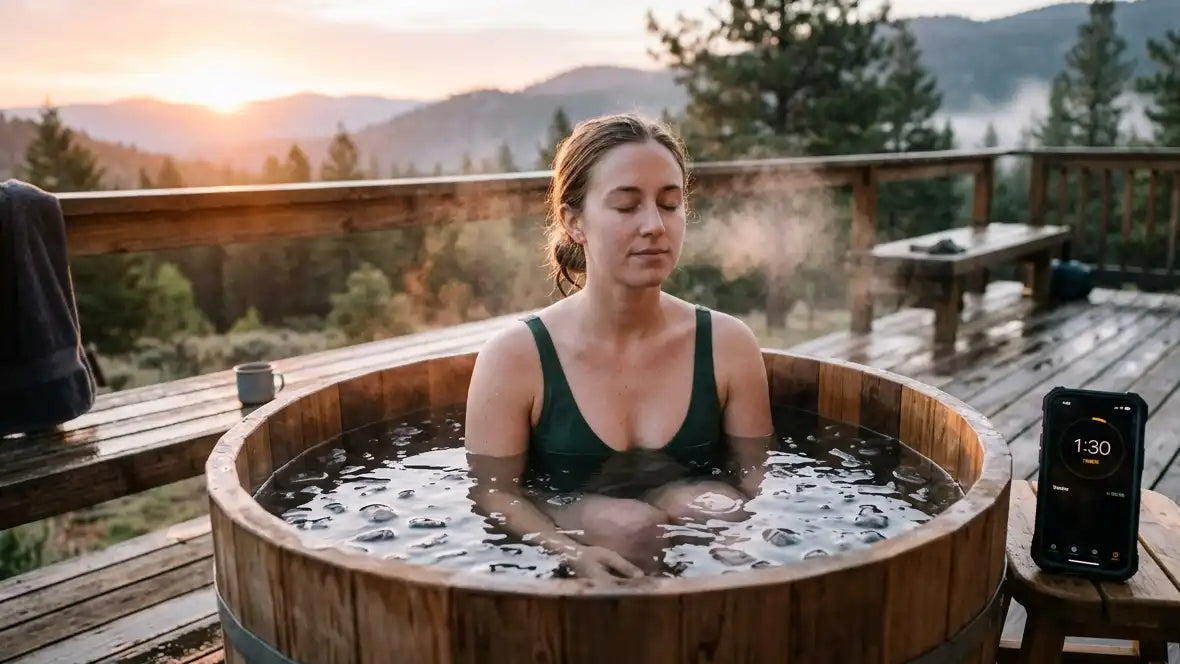
You are standing next to a tub of cold water. Part of you wants to get in. The other part wants to go make a coffee and forget the whole idea. Sound familiar? The one question holding most people back is simple: how long do I actually have to stay in there? Here is the honest answer. For your first ice bath, 30 seconds to 2 minutes is enough. Not ten minutes. Not five. Two minutes, at most. The cold does its work fast, and your first session is about learning, not enduring. This guide walks you through the right time for your temperature, what those first two minutes really feel like, and how to get out before your body wants you to.

30 Seconds to 2 Minutes
Your first ice bath should last between 30 seconds and 2 minutes. That is it. It may sound short, but the cold shock response peaks in the first minute, and that response is where most of the benefit lives.
Staying longer does not earn you extra points. Once your breathing settles and your body calms down, the main work is done. Push past 5 minutes on day one and you are more likely to come out drained and shivering than energized. There is no prize for suffering.
So set a timer for 2 minutes, and give yourself full permission to get out at 30 seconds. Both count as a win. Anyone can do 30 seconds, including you.
Match Your Time to the Water Temperature
Time means nothing without temperature. Two minutes in 15 °C water is a very different experience from two minutes at 5 °C. The colder the water, the shorter you should stay. Simple as that.
Most first-timers do not need extreme cold. Water at 12–15 °C already feels shockingly cold to an unadapted body, and it gives you room to practice your breathing without panic.
| Water temperature | First-timer duration | With a few weeks of practice |
|---|---|---|
| 15–20 °C (59–68 °F) | 1–2 minutes | 2–5 minutes |
| 10–15 °C (50–59 °F) | 30 sec – 2 minutes | 2–3 minutes |
| 5–10 °C (41–50 °F) | 30 – 60 seconds | 1–3 minutes |
| Below 5 °C (41 °F) | Not recommended for a first session | 1–2 minutes |
Ranges compiled from beginner guidance published by Healthline and the Wim Hof Method.
One practical note: a bathtub with ice bags rarely holds a steady temperature, so check it with a cheap floating thermometer before you get in. If you end up plunging regularly, a tub paired with a water chiller keeps the water at one exact temperature, which takes the guesswork out of timing.
Why Your Time Is Different From Everyone Else's
Maybe your friend lasted four minutes on their first try. Maybe someone online claims they did twenty. Forget them. Your right duration depends on a few things that are personal to you:
- Body composition. More muscle and body fat means better insulation. Lean people cool down faster and should start shorter.
- Cold experience. If you already finish your showers cold, your body has a head start. Total beginners should stay at the low end.
- Your goal. After a hard workout, 2–3 minutes covers recovery. If you just want the mental reset and the mood lift, even one minute does the job.
- Time of day. Most people tolerate cold better in the morning than at night. An evening plunge close to bedtime can also make it harder to fall asleep.
The point is not to hit a number. The point is to find the time where you feel challenged but still in control.
Recommended Products


What the First Two Minutes Actually Feel Like
Nobody tells beginners this part, so here it is, second by second.
0–15 seconds
You get in, and your body protests. You gasp. Your heart races. Your skin stings everywhere at once. This is the cold shock response, and it is completely normal. It is not danger. It is just noise.
15–45 seconds
The sting starts turning into a dull, heavy cold. Your breathing is still fast, but you can begin to slow it down. This is the window where most first-timers want to quit. Hold on a little longer if you can.
45 seconds – 2 minutes
Something surprising happens. Your breath settles. Your mind goes quiet. The water is still freezing, but you are okay in it. Many people describe this as the calmest they have felt all week.
After you get out
Expect a warm rush and a genuine lift in mood. About ten minutes later you may feel a second wave of cold as chilled blood returns from your limbs to your core. This is called afterdrop. It passes on its own, so dry off, put on warm clothes, and move around a little.

Breathe Your Way Through the First 30 Seconds
Your breath is the only part of the shock response you can control directly. Control it, and the rest follows. Try this:
- Before you get in: take ten slow, deep breaths. In through the nose, out through the mouth. Nothing fancy.
- As you lower yourself in: exhale. A long, steady exhale as the water rises presses back against the gasp reflex.
- In the water: make every exhale longer than the inhale. Count four in, six out, and repeat.
- If your breathing runs away from you: pause, hold for two seconds, and restart the slow exhale. Still can't settle it after a minute? Get out. There is always tomorrow.
One safety rule: never do intense breathing exercises like full Wim Hof rounds while you are in the water. Do them before, on dry land, sitting down.
Six Signals That Mean Now
Shivering a little and thinking "this is cold" is normal. The following signs are not. Get out right away if you notice:
- Dizziness or light-headedness
- Chest pain or pressure
- Breathing you cannot bring under control
- Fingers or toes changing color (white, blue, or gray)
- Violent shivering that will not ease
- Losing fine motor control – if you cannot tap your fingers together, your time is up
And a rule that applies to everyone: do not take your first ice bath alone. Have someone nearby. If you have a heart condition, high blood pressure, poor circulation, or you are pregnant, talk to your doctor before you start.
A Simple 4-Week Plan
One ice bath feels great. A regular practice changes how you handle stress everywhere in your life. Here is how to build up without rushing:
- Week 1: 2 sessions, 15–18 °C, 1 minute each. Focus only on breathing.
- Week 2: 2–3 sessions, same temperature, stretch to 90 seconds – 2 minutes.
- Week 3: 3 sessions, drop to 12–15 °C, hold at 2 minutes.
- Week 4: 3 sessions, 10–13 °C, 2–3 minutes.
Progress by lowering the temperature before adding time. And if buying bags of ice every session gets old fast, a simple portable cold plunge tub or a dedicated ice bath tub makes the habit far easier to keep. For the full setup walkthrough, from cold showers to a complete routine, see the beginner's guide to cold plunging.
7 Mistakes First-Timers Make
- Jumping in fast. Enter slowly and with control. Your nervous system will thank you.
- Competing on time. Someone else's four minutes is not your target. Ego has no place in cold water.
- Staring at the timer. Set it, place it out of easy view, and put your attention on your breath instead. The seconds move faster that way.
- Rushing into a hot shower afterward. Let your body rewarm naturally with dry clothes and light movement first. The gentle rewarming is part of the training.
- Going in alone. Cold reduces strength and coordination. Have someone around, at least for the first few sessions.
- Plunging after alcohol or on an empty stomach. Both make the cold hit harder and riskier.
- Ignoring health conditions. Heart issues, blood pressure problems, Raynaud's, pregnancy – check with a doctor first, not after.
Summary
For your first ice bath, keep it between 30 seconds and 2 minutes in water around 10–15 °C, and never force yourself past 5 minutes. Enter slowly, exhale long, and let the first 45 seconds of shock pass before you judge the experience. Get out at the first sign of dizziness, uncontrolled breathing, or color changes in your fingers and toes, and always have someone nearby. From there, build gradually over four weeks by lowering the temperature before adding time. The cold never becomes comfortable. You simply become someone who can handle it, and that starts with two brave minutes.
FAQs
How long should a beginner stay in an ice bath at 50 degrees?
At 50 °F (10 °C), a beginner should stay in for 30 seconds to 2 minutes. That temperature is cold enough to trigger the full response, so short sessions are plenty. Add 15–30 seconds per week as your body adapts.
Can you stay in an ice bath too long as a beginner?
Yes. Staying past 10 minutes raises the risk of hypothermia and adds no extra benefit. Beginners should treat 5 minutes as a hard ceiling and get out earlier if they feel dizzy, numb, or unable to control their breathing.
What temperature should an ice bath be for your first time?
Aim for 12–15 °C (54–59 °F) for a first session. It should feel uncomfortably cold but manageable. Lower the temperature step by step over the following weeks rather than starting near freezing.
Is 1 minute in an ice bath enough to get benefits?
Yes. One minute in properly cold water is enough to trigger the cold shock response, the mood lift, and the start of cold adaptation. Consistency across the week matters more than the length of any single session.
Should I take an ice bath every day as a beginner?
Not at first. Two to four sessions per week gives your body time to adapt and keeps the habit from burning out. Daily plunges can come later, once 2–3 minutes at 10–15 °C feels routine.


