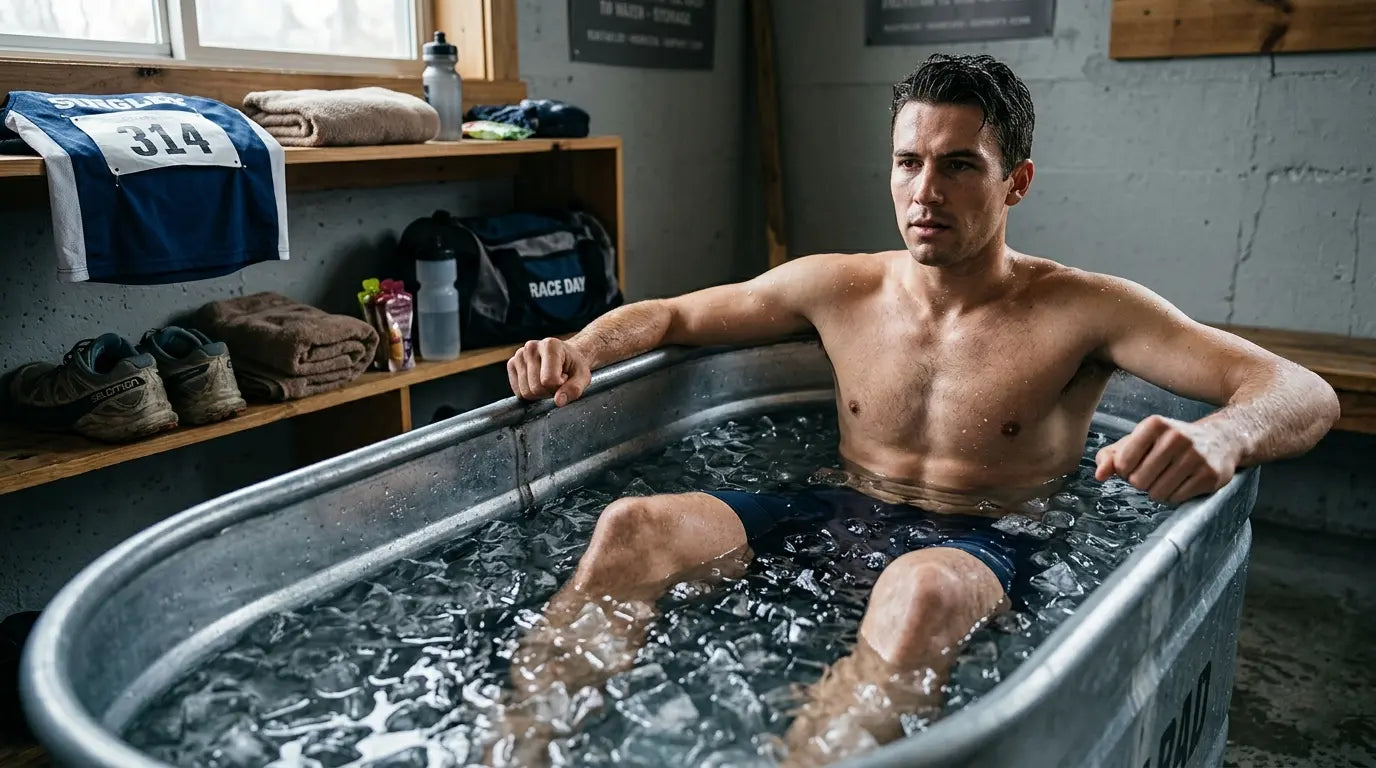
The evening before a race hits every endurance athlete the same way: heavy legs, restless sleep, a mind that won't switch off. Some reach for an ice bath — the so-called "leg reset."
But does it actually help, or does it just add another variable the night before your biggest effort?
This guide cuts straight to it. We cover the science, the practical how-to, and who should and shouldn't use it.

Which Races Actually Benefit from a Pre-Race Ice Bath?
Not every event warrants cold water immersion the day before. Knowing whether it applies to your race matters more than knowing how to do it.
Endurance Events (Highly Recommended)
Marathons, half-marathons, triathlons, and ultra-marathons put huge strain on muscles recovering from exertion, plus they require a lot of work to keep your core temperature regulated. An ice bath before your race allows you to eliminate some of that residual inflammation, so your legs will be in better condition when you get to the start line.
Hot Weather Racing (Strongly Recommended)
Ice baths demonstrate their greatest benefits in reducing the measurable value of pre-cooling due to the extreme temperatures and humidity found in many races today. Multiple studies have shown how pre-cooling can reduce core temperatures between 0.5 and 1 degree Celsius and allow for more than a 16 percent increase in endurance in many cases, as well as delaying the onset of fatigue and providing an overall greater return on investment.
Multi-Day Stage Races
Races that last 7 days and cycling events that are multi-stage mean the days for recovery (after racing) and preparation (for racing) are one and the same. Therefore, using ice baths serves two purposes; they help you recover from yesterday's damage and prepare you for tomorrow's race.
Power and Explosive Sports (Use with Caution)
Weightlifting, sprints and Cross Fit competitions depend on explosive power in the neuromuscular system. Cold water immersion can lead to temporary stiffness in the muscles, resulting in reduced reaction time and decreased peak force output. If you are concerned about race day anxiety, only do cold water immersion for less than 8 minutes and use it strictly as a relaxation technique.

When to Skip It
- Short, single-burst events — long jump, shot put, 100m sprints
- Cold race environments where maintaining body temperature outweighs pre-cooling
- First-time users — the day before a race is never the moment to experiment


What Does a Pre-Race Ice Bath Actually Do?
Physical Benefits
"Heavy legs" often have low-grade inflammation from training the day before. Cold water causes vasoconstriction which quickly reduces local inflammation. Vasodilation during rewarming causes removal of waste products, returning the muscles to a readiness state.
Rewarming is planned to coincide with the lower temperature required for deep sleep, providing an improvement in quality of sleep due to pre-race excitement or nervousness.
Mental Benefits
Cold water shock triggers the parasympathetic nervous system, which calms the body and offsets any adrenaline buildup before competition. At the same time, norepinephrine and dopamine are being released from the body, leaving athletes feeling alert, calm, and focused.
Ritual is also important. Elite athletes incorporate ice baths into their race day routines not just for physiological management but as a way of signalling that they have prepared and are now ready. Studies show that athletes who have confidence in the benefits of cold immersion experience greater gains from it than those who do not. Placebo is not
a dirty word in performance settings.
Potential Risks of Pre-Competition Ice Bath
Temporary muscle stiffness: Muscles tighten for 1–2 hours post-bath. This usually resolves on its own, but if you ice bath and go straight to sleep, legs may feel tight first thing in the morning.
Sleep timing trap: Taking an ice bath within 1–2 hours of sleep can interfere with falling asleep as the body rewarming process raises alertness. Aim for late afternoon, not bedtime.
Mixed scientific evidence: A 2017 Journal of Physiology study found cold water immersion offered no significant advantage over active recovery. Most existing research involves small samples and high individual variability — "ice baths definitely work" remains moderate-confidence evidence.
High risk for first-timers: Without prior adaptation, cold shock can trigger a stress response that disrupts sleep and race-day readiness. Never introduce ice baths the night before competition.
Medical contraindications: Athletes with high blood pressure, arrhythmia, or Raynaud's syndrome should consult a doctor before using cold immersion.

What Elite Athletes and Coaches Actually Do
US 50K national champion Emily Harrison uses a periodized approach: minimal ice baths early in the training cycle, increasing frequency over the final month before a goal race. Her logic: if the ice bath is familiar, it's a weapon. If it's unfamiliar, it's a liability.
Coach Greg McMillan's take is similarly direct: pre-race ice baths aren't primarily about further recovery — they're about resetting how legs feel and giving athletes a sense of active control before race day.
Bernard Lagat's 2007 World Championship 1500m victory was followed by an ice bath that same evening, with a 5000m preliminary heat the next morning. An extreme case — but it illustrates the tolerance and confidence that comes from systematic, habitual cold exposure.
The common thread among coaches and athletes: if regular ice baths are already part of your training, using one the night before a race is safe and usually beneficial. If they're not, don't start now.
Pre-Race Ice Bath Protocol
Timing
The ideal window is 18–24 hours before race start — typically late afternoon or early evening the day before. This leaves enough time for muscles to rewarm and relax, without the benefits fading entirely.
Avoid cold immersion within 2 hours of sleep. The rewarming effect raises alertness and can delay sleep onset.
Temperature and Duration
- Target water temperature: 10–15°C (50–59°F)
- Standard duration: 10–15 minutes
- Pre-race recommendation: stay under 10 minutes — conservative is right
- Hard limit: 20 minutes maximum to avoid hypothermia risk
Step-by-Step Protocol
- Fill the tub with cold water first, then add ice gradually to reduce the initial shock
- Once in, focus on breathing — slow 4-second inhales, 4-second exhales activate the parasympathetic response
- After exiting, wrap in a large towel and rewarm naturally — don't jump straight into a hot shower
- Walk lightly for 5–10 minutes to help circulation return to the extremities
- Have a warm drink to stabilize body temperature from the inside
Non-Negotiable Rule
Never use an ice bath for the first time the night before a race. No exceptions.
The value of a pre-race ice bath is built on familiarity and habituation. Make it part of your regular training, and it becomes a genuine performance tool. Treat it as a one-time fix, and it becomes a risk.

Who Should — and Shouldn't — Ice Bath Before a Race?
Strongly Recommended
- Endurance athletes who already ice bath regularly (1–2x per week minimum)
- Athletes racing in hot or humid conditions where pre-cooling is measurably beneficial
- Multi-day stage race competitors where recovery and preparation overlap
- Athletes with significant pre-race anxiety who use cold exposure for mental grounding
Can Consider It
- Athletes with some cold exposure experience who feel residual leg heaviness heading into race week
- Those who struggle to fall asleep before big races and want to use the rewarming effect
Skip It
- First-time ice bath users — never before a race
- Athletes with high blood pressure, arrhythmia, or Raynaud's syndrome
- Pure power and speed sports: sprinting, jumping, throwing
- Cold race environments where maintaining warmth matters more than pre-cooling
The Bottom Line
If ice baths are already part of your training — go for it. Your body knows the stimulus, and the combination of physical and psychological benefits is well worth the effort, especially for endurance and hot-weather racing.
If you've never taken an ice bath before — skip it this time. The risk isn't the cold itself. It's the unfamiliarity. Add cold exposure to your training now, and use it as a pre-race tool at your next event.
The real takeaway: an ice bath isn't a last-minute fix. It's a training habit that, when practiced consistently, becomes a confidence switch you can flip the evening before a race.


