You finish a hard workout. Your legs feel fine. Then you wake up the next morning barely able to walk down the stairs. That two-day delay is your body working through the aftermath of intense exercise — and if you've ever climbed into a tub of ice-cold water hoping to speed up the process, you're not alone. But does an ice bath help with soreness, or is it just a painful habit that feels productive?
The short answer is yes — with real caveats. Cold water immersion can reduce how sore you feel in the days after hard training, but it doesn't work for everyone, it doesn't work the same way for every type of workout, and using it wrong can actually set back your progress. This guide breaks down what actually happens in your body, what the research shows, and how to decide whether an ice bath belongs in your recovery routine.
How an Ice Bath Works: The Physiology
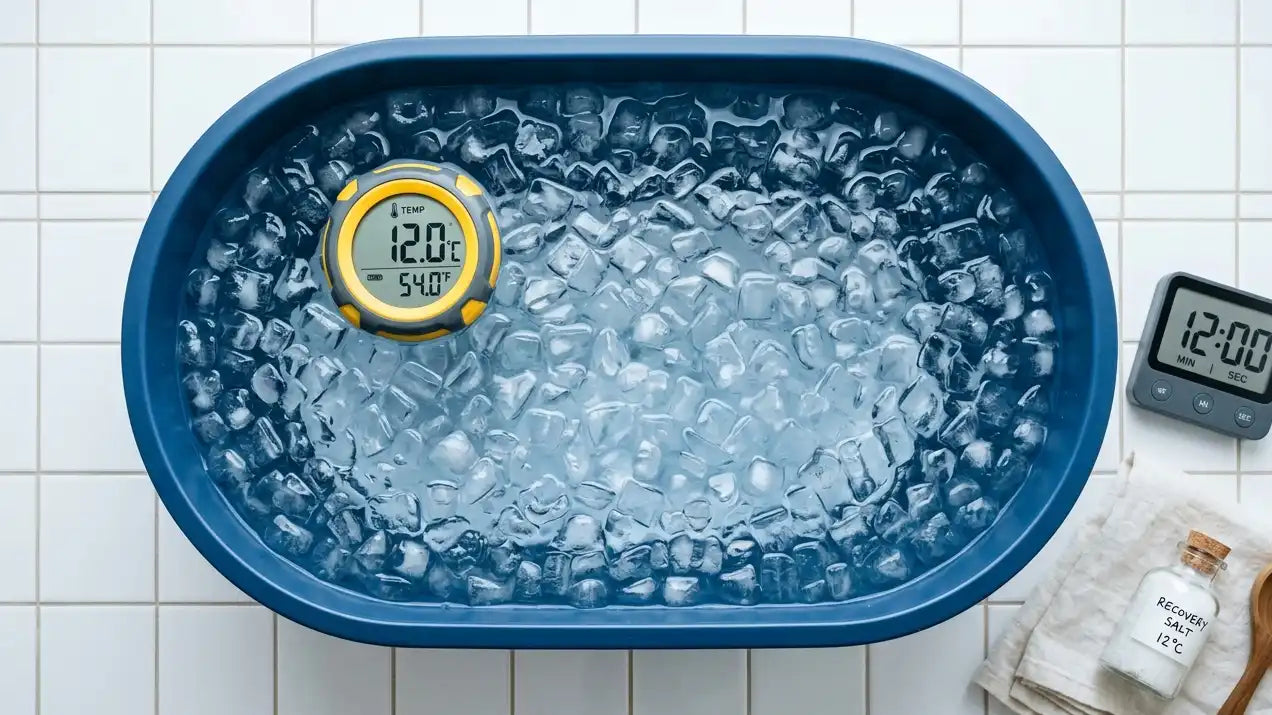
When you step into cold water — ideally between 10°C and 15°C (50°F–59°F) — your body reacts fast. Blood vessels near the surface and in your limbs constrict, pushing blood away from the extremities and toward the core. This is called vasoconstriction, and it's the driving force behind most of the benefits people attribute to cold plunges.
Here's the sequence:
- Cold exposure → vasoconstriction: Blood flow to muscles drops. Inflammatory signals slow down. Tissue swelling is reduced.
- Exit the water → vasodilation: Blood vessels open back up. Fresh, oxygenated blood rushes into the muscles. Metabolic waste — lactic acid, cellular debris — gets flushed out.
- Pain signals slow down: Cold also reduces nerve conduction velocity, which is a clinical way of saying it temporarily numbs the pathways that carry pain signals. You feel less sore not just because of reduced inflammation, but because your nervous system is processing pain signals more slowly.
This combination of reduced swelling, improved waste clearance, and slower nerve signaling explains why an ice bath can make you feel noticeably better within an hour of a tough workout.

What Is DOMS, and Can Ice Baths Actually Reduce It?
DOMS — delayed-onset muscle soreness — is the stiffness and aching you feel 24 to 72 hours after exercise, especially unfamiliar or high-intensity effort. It's caused by microscopic damage to muscle fibers, the local inflammation that follows, and fluid shifts in the tissue that put pressure on nerve endings.
Ice baths target DOMS directly. The cold-water intervention works best when applied within one to two hours of finishing exercise, before the inflammatory cascade has fully built up. Think of it as getting ahead of the traffic jam rather than sitting in it.
That said, the effect is meaningful but modest. Studies that have looked at this consistently find that cold-water immersion reduces perceived soreness by around 15–20% over the following days. That might not sound like much, but if you're an endurance athlete training twice a day, or a team sports player with back-to-back competition days, that margin matters.
One thing to be clear about: ice baths reduce how sore you feel. They don't necessarily speed up the underlying repair of muscle tissue. For many athletes, that distinction doesn't matter — feeling less sore means training harder the next session. But it's not the same as healing faster.
Recommended Products


What the Research Actually Shows
The honest picture from the research is mixed — not because cold water doesn't do anything, but because the studies vary a lot in quality, design, and who they tested.
Where the evidence is fairly consistent:
- Cold water immersion outperforms passive rest for reducing perceived soreness in the short term
- The effect is most reliable after aerobic and high-intensity interval training
- Athletes in dense competition schedules (e.g., multi-day tournaments) recover faster between events with cold-water use
- 10–15°C water temperature range consistently performs well across studies; going colder doesn't improve results
Where it gets more complicated:
- Most studies involve small groups, short timeframes, and predominantly male participants
- The benefit over active recovery (light cycling, walking) is less clear — some studies show active recovery works equally well
- Blood markers of actual muscle damage (like creatine kinase) don't improve as consistently as self-reported soreness, raising questions about whether the effect is partly perceptual
- A 2025 meta-analysis involving over 3,000 healthy non-athlete adults found that benefits vary significantly based on the individual and the specific method used
The takeaway: for reducing how sore you feel after hard training, cold water works. For speeding up actual tissue repair or improving long-term performance, the evidence is more uncertain.
Temperature and Duration: Getting the Protocol Right
This is where a lot of people go wrong — assuming that colder is better, or that staying in longer means more benefit.

Optimal temperature range: 10°C–15°C (50°F–59°F)
Going colder than 10°C doesn't add meaningful benefit and increases your risk of cold shock, nerve issues, and skin damage. Interestingly, research comparing 10–15°C water with sub-10°C water often finds no difference in soreness reduction — and the colder exposure is harder to tolerate, which affects how long people actually stay in.
Optimal duration: 10–15 minutes
Benefits plateau after about 15 minutes. Staying longer exposes you to risks like hypothermia and frostbite without any additional recovery advantage. If you're new to cold water immersion, start at 3–5 minutes and build up gradually.
| Parameter | Recommended | What to Avoid |
|---|---|---|
| Water temperature | 10–15°C (50–59°F) | Below 8°C — no added benefit, higher risk |
| Duration | 10–15 minutes | Over 15 minutes — diminishing returns |
| Body position | Submerge to waist/chest | Full-head submersion unless experienced |
| Water after | Gradual rewarming | Immediate hot shower — causes blood pressure drop |
| First session | Start at 3–5 minutes | Jumping straight to maximum duration |
After the ice bath: Dry off, put on warm clothes, and let your body rewarm naturally. Resist the urge to jump straight into a hot shower — the rapid temperature shift can cause lightheadedness. Moving around gently is a better option.
For athletes thinking about setting up a consistent home routine, IceDragon's range of ice bath tubs with chillers lets you dial in an exact temperature without the hassle of bags of ice.
When to Use an Ice Bath (and When to Skip It)
Timing matters as much as temperature.
Best time to use one:
- Within 1–2 hours post-workout, while the inflammatory response is still building
- Before a second training session or competition the same day
- During high-volume training blocks when cumulative fatigue is a concern
When to skip it:
- Immediately after strength training if building muscle is your main goal (more on this below)
- On lighter recovery days when the body's natural repair process doesn't need interrupting
- If you're dealing with an acute injury that needs proper medical attention — cold water may mask pain that's actually a signal
Frequency:
- Endurance or team sport athletes in heavy training: can be used after each demanding session
- General fitness / strength focus: 1–2 times per week at most, and never immediately post-lift

The Case Against Ice Baths
The inflammation that makes you feel sore after lifting is also a key part of how your muscles grow. When muscle fibers break down during resistance training, the inflammatory response triggers a chain of repair signals — your body rebuilds the damaged fibers thicker and stronger. That's the whole point.
Cold water suppresses that inflammatory response. For soreness relief, that's the benefit. For muscle building, it's a problem.
A 12-week study comparing post-workout ice baths against active recovery (low-intensity cycling) found that the ice bath group gained significantly less muscle mass and strength. A 2024 meta-analysis reached a similar conclusion: regular cold water immersion after resistance training modestly but consistently blunts hypertrophic adaptations — meaning it slows how much your muscles grow.
A 2025 study from Maastricht University added more detail: cold water immersion reduced muscle blood flow by around 60% after exercise, which directly cut off the supply of amino acids needed for muscle protein synthesis. The muscles weren't getting the raw materials to rebuild.
The practical rule:
- Training for endurance, performance, or general fitness → ice baths can be useful
- Training primarily to build muscle or strength → avoid ice baths within 4–6 hours of your lifting session
If you're in a mixed-training program — some cardio, some lifting — time your cold exposure after your aerobic sessions, not your strength work.
For a fuller look at the benefits and tradeoffs across different goals, the IceDragon guide on whether ice baths are good for you covers this in useful depth.
Ice Bath vs Hot Bath vs Contrast Therapy
Cold water isn't the only post-workout recovery tool, and it's not always the right one. Here's how the main options compare.

Ice bath: Fast-acting reduction in soreness and inflammation. Best suited to acute recovery in the 0–24 hours after hard effort, especially endurance or team sport training.
Hot bath: Promotes muscle relaxation, increases blood flow, and eases chronic stiffness and joint discomfort. More useful 24+ hours after training when the acute inflammation has passed. Not ideal for the same-day recovery window.
Contrast therapy (alternating hot and cold): This method cycles between cold and warm immersion — a common protocol is one minute cold, two minutes warm, repeated three times, finishing on cold. It creates a pumping effect in the circulatory system that may improve recovery better than either extreme alone. Many athletes who combine sauna with cold plunging are essentially doing contrast therapy. For more on the optimal sequence, IceDragon's guide on sauna vs cold plunge order explains the mechanics clearly.
| Situation | Best Option |
|---|---|
| Acute soreness, same day as workout | Ice bath |
| Chronic muscle stiffness or joint aches | Hot bath |
| Competition day recovery between events | Ice bath |
| General relaxation and wind-down | Hot bath or contrast |
| Post-strength training (muscle gain focus) | Skip cold — use hot or active recovery |
| Sauna available + time allows | Contrast therapy (sauna → cold plunge) |
Gender Differences and Individual Variation
Most cold water immersion research has been done on young men, which creates a blind spot in the existing evidence.
A 2024 trial specifically studied women recovering from exercise-induced hamstring damage using cold water immersion at 14°C for 15 minutes over five consecutive days. It found measurable recovery benefits — but also noted that the response patterns differed from what male-participant studies typically show. Women's thermoregulation, hormonal fluctuations across the menstrual cycle, and body composition differences all affect how cold water works in practice.
Individual variation beyond gender is also significant:
- Age: Older adults are more sensitive to cold, tolerate it less well, and should use warmer water (closer to 15°C) for shorter durations
- Training status: Highly trained athletes appear to get less dramatic subjective relief from ice baths, possibly because their baseline inflammatory response to training is already more controlled
- Cold tolerance: Some people find 12°C easily manageable; others find the same temperature genuinely stressful. The psychological experience affects outcomes — if the cold triggers a severe stress response, the benefits may be blunted
- Training type: The benefit-to-risk ratio is genuinely different for an endurance athlete vs. a powerlifter, as covered in the section above
The honest conclusion: there's no universal ice bath prescription. Start with the parameters above, pay attention to how your body responds session by session, and adjust. A recovery tool that works well for someone else may not be the right fit for you.
Summary
Ice baths can meaningfully reduce delayed-onset muscle soreness — typically by 15–20% — and are most effective when used within 1–2 hours of endurance or high-intensity training, at a temperature of 10–15°C for 10–15 minutes. The mechanism is straightforward: cold causes vasoconstriction that limits inflammation and slows pain signals, followed by a rebound of circulation when you warm up. The main limitation is that the same anti-inflammatory effect that reduces soreness can interfere with muscle growth when used regularly after resistance training, making ice baths a poor fit for strength-focused programs. Hot baths and contrast therapy offer viable alternatives depending on your training type and timing. Individual factors — gender, age, training background, and cold tolerance — all influence how much you'll actually benefit, so treating the general guidelines as a starting point rather than a fixed rule is the most practical approach.
FAQ
How long after a workout should you take an ice bath for sore muscles?
The sweet spot is within one to two hours of finishing exercise, while the inflammatory response is still developing. Getting in during this window lets cold exposure get ahead of the soreness before it peaks. Waiting more than four hours reduces the benefit significantly, though some relief is still possible within 24 hours for very intense training.
Does an ice bath help with sore muscles the next day or only right after exercise?
Most of the research supports taking the ice bath soon after exercise rather than waiting until soreness kicks in. That said, cold immersion the following day can still reduce perceived soreness, particularly in the 24–48 hour window when DOMS is at its worst. It won't reverse the damage, but it can make the day more manageable.
Should you take an ice bath after every workout to prevent soreness?
Not necessarily — and if strength or muscle size is your goal, you probably shouldn't. Daily cold water immersion after resistance training has been shown to blunt muscle protein synthesis, which is the process that makes muscles grow. For endurance-focused training, using it after particularly hard sessions (not every session) tends to be more sustainable and better for long-term adaptation.
Is a cold shower as effective as an ice bath for muscle soreness?
Cold showers do trigger some of the same physiological responses — vasoconstriction, slowed nerve conduction — but the effect is less consistent and generally milder than full immersion. The difference comes down to full-body exposure vs. partial contact, and the sustained nature of immersion. A cold shower is a reasonable alternative if an ice bath isn't accessible, but it's not a direct substitute.
What temperature should an ice bath be for maximum soreness relief?
Research consistently points to 10–15°C (50–59°F) as the most effective and practical range. Colder water — below 8°C — doesn't appear to produce better results for soreness and comes with increased risks. A number of studies have found that moderate temperatures in this range perform as well as colder protocols while being far easier to tolerate, which means people actually stay in long enough to get the benefit. If you're thinking about getting a dedicated cold plunge setup at home, check out the IceDragon cold plunge tubs, which let you set a precise temperature without needing bags of ice.


