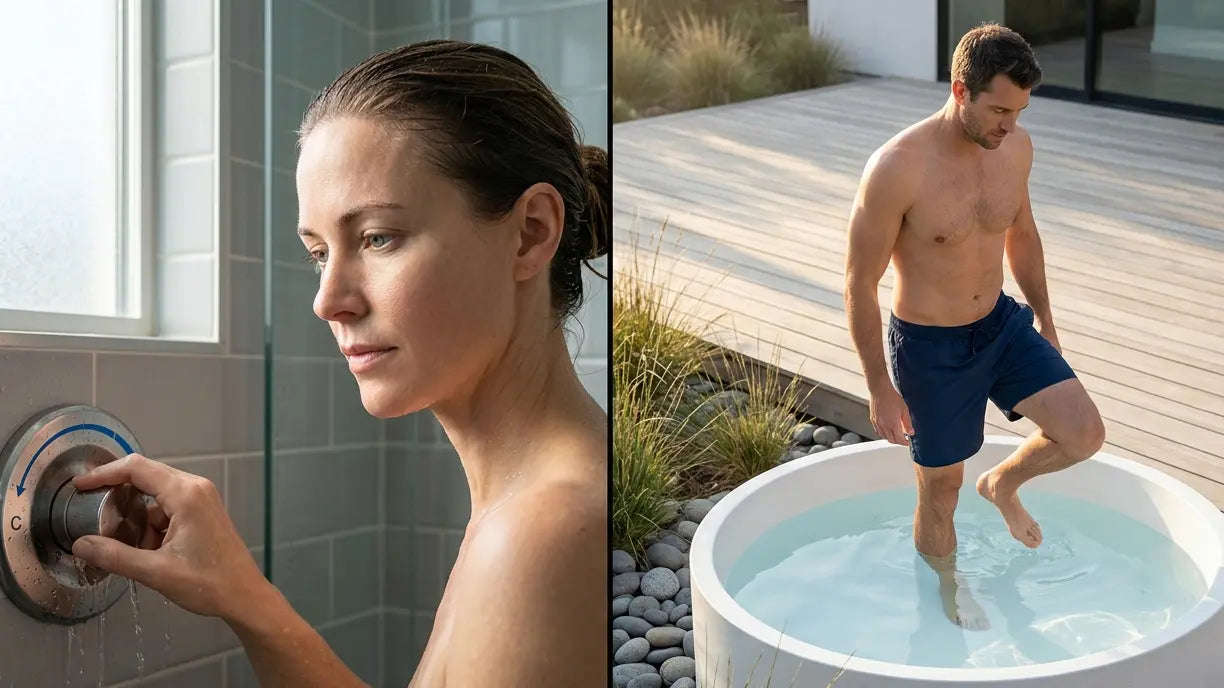
Most people who start cold therapy face the same question: do you really need a dedicated plunge tub, or is a cold shower good enough? The honest answer depends on what you're actually trying to get out of it. Both methods involve cold water, both create physiological stress your body adapts to, and both have real benefits. But they are not the same thing — and knowing the difference can save you time, money, and a lot of frustration when results don't match your expectations.
What Is a Cold Shower?
A cold shower is exactly what it sounds like: you turn the dial to cold and stand under the water for a set period of time. No equipment required, no preparation beyond turning a handle.
In practice, "cold" usually means anything below 60°F (15°C). Depending on where you live and the time of year, your home's tap water may land anywhere from the low 50s°F in winter to the upper 60s°F in summer. That variability matters more than most people realize.
Most people start with 30–60 seconds and work up from there. A session of 2–3 minutes is typical once you've built some tolerance.

What Is a Cold Plunge?
A cold plunge involves submerging your body — usually up to the neck — in a tub of cold water. The water temperature is typically between 37°F and 59°F (3–15°C), and sessions generally run 2–15 minutes depending on your experience level and goals.
Unlike a cold shower, a plunge surrounds your entire body simultaneously. There's nowhere to shift away from the cold, and the temperature stays consistent throughout the session.
People use ice baths filled manually, purpose-built plunge tubs, or tubs paired with a water chiller for precise temperature control. The setup is more involved than a shower, but it's that commitment and control that make the experience different.

Why the Gap Matters More Than You'd Think
The single biggest mechanical difference between a cold shower and a cold plunge is temperature — specifically, how cold the water actually gets and how consistently it holds that temperature.
Home tap water in most parts of the US or Europe sits between 55–70°F, even in winter. That might feel jarring when you first step in, but it's still considerably warmer than the 37–55°F range a proper cold plunge can reach with a chiller or ice.
Beyond absolute temperature, water temperature determines the intensity of your body's response. Cold exposure triggers the release of norepinephrine and dopamine — the chemicals behind the mood lift, focus, and recovery benefits people report. That response scales with how cold the stimulus is. At 70°F, the effect is mild. At 45°F, it's substantially stronger.
There's also the consistency factor. In a cold shower, the water hitting your skin is immediately warmed slightly by your body heat as it runs off. A plunge tub holds a stable temperature throughout your session because the water volume is much larger relative to your body.
| Cold Shower | Cold Plunge | |
|---|---|---|
| Typical temperature | 55–70°F (13–21°C) | 37–59°F (3–15°C) |
| Temperature control | None — depends on plumbing | High — chiller or ice |
| Temperature consistency | Drops as water hits skin | Stable throughout |
| Body coverage | Sequential (wherever water flows) | Uniform, full-body simultaneous |
| Required equipment | None | Tub, plus chiller or ice |
| Typical session length | 2–5 minutes | 3–15 minutes |
| Relative intensity | Moderate | High |
Key Differences Between Cold Showers and Cold Plunges
Temperature is the foundation, but the differences run deeper than that.
Coverage and physiological response
When you stand under a cold shower, the water hits one part of your body at a time. Your front is cold while your back is warmer. You rotate, adjust, shift. The nervous system response is real, but it's partial.
In a plunge, every surface of your skin meets cold water at the same moment. That full simultaneous exposure triggers a much stronger autonomic nervous system response — your heart rate adjusts, your breathing changes, and the hormonal release is more pronounced. It's the difference between pressing one key on a piano versus a chord.
Hydrostatic pressure
This one rarely gets mentioned but matters for recovery: when you're submerged, water exerts pressure on your body that actively pushes blood back toward the heart. That pressure — called hydrostatic pressure — helps clear inflammation from muscles and joints in a way a shower simply cannot replicate. It's one reason athletes have used ice baths for decades.
Vagus nerve stimulation
Cold water on your face and neck stimulates the vagus nerve directly, which triggers a calming parasympathetic response. A cold shower hits this area. A cold plunge surrounds the entire upper body including the neck, producing a longer and more consistent stimulation.
Mental commitment
In a shower, you can step sideways, turn down the cold slightly, or just step out. In a plunge, you're in. That forced commitment changes the psychological experience. For people building mental resilience or stress tolerance, that element of no-escape matters.
Recommended Products


Convenience and Accessibility
This is where cold showers have a clear edge, and it's not close.
Cold showers:
- Zero setup time
- No additional equipment or cost
- Available anywhere with running water — home, hotel, gym
- Can be done daily without any planning
- Easy to fold into an existing morning or post-workout routine
Cold plunges:
- Require a tub, a water source, and either ice or a chiller
- Setup takes 5–20 minutes depending on your system
- Maintaining water cleanliness requires ongoing attention
- Not portable for most people
- Cost ranges from under $100 for a DIY bucket setup to several thousand dollars for a premium chiller-equipped tub
If consistency is your biggest challenge — and for most people it is — cold showers win on friction alone. The best cold therapy practice is the one you'll actually do.
That said, if you're serious about recovery or mental performance benefits, the convenience gap between a home plunge setup and a shower has narrowed considerably. A portable tub like the IceDragon Portable Cold Plunge Tub sets up in under 10 minutes, stores flat, and works in a backyard or garage — which removes most of the friction people associate with plunge setups.
Cost Comparison
Cold showers cost essentially nothing. You're using water you'd use anyway, just colder.
Cold plunges involve an upfront investment. Here's a rough breakdown of what different setups cost:
| Setup type | Approximate cost | Best for |
|---|---|---|
| DIY (bathtub + ice bags) | $0–$15 per session | Testing the waters, no commitment |
| Portable inflatable tub | $80–$200 | Beginners, limited space |
| Mid-range insulated tub | $200–$600 | Regular home use without a chiller |
| Tub + entry-level chiller | $800–$1,500 | Consistent temperature control |
| Tub + premium chiller | $2,000–$4,000+ | Serious practitioners, daily use |
| Gym / spa drop-in | $20–$60 per session | Those not ready to invest at home |
When you factor in how often you'd use it, the per-session cost of a home tub comes down quickly. Someone using a $1,200 setup three times a week for two years ends up spending roughly $3–4 per session — comparable to a gym visit.
If you're looking at chiller options specifically, IceDragon's water chillers for ice bath cover a range of cooling capacities and are designed specifically for home cold plunge use.
Which One Is Better — And How Do You Choose?
Neither is universally better. The right answer depends on your goals, budget, and how much friction you can tolerate in a routine.
Choose cold showers if:
- You're new to cold therapy and want to build the habit first
- Your main goal is morning energy, alertness, or a daily mood reset
- Budget or space is a constraint
- You want something you can do every single day without planning
Choose cold plunges if:
- Muscle recovery after training is a primary goal
- You want the strongest possible hormonal and neurological response
- You're building toward specific performance or mental resilience outcomes
- You've already established a cold shower habit and want more
The best approach for most people: start with cold showers, add plunges later.
Cold showers build your tolerance and teach you how to manage cold shock. That foundation makes cold plunges safer and more productive when you eventually make the jump. You also get a clearer sense of whether cold therapy actually suits you before spending anything on equipment.
Many consistent practitioners end up using both: cold plunges 3–4 times a week for depth of benefit, cold showers on other days to maintain the habit. There's no rule against combining them.

How to Get Started: Practical Beginner Tips
Starting with cold showers:
- Finish your normal warm shower, then switch to cold for 30 seconds
- Focus on breathing — slow exhales are the key to staying calm
- Build to 2 minutes over 1–2 weeks
- Once 2 minutes feels manageable, try starting your shower cold from the beginning
Starting with cold plunges:
- Begin at a water temperature around 55–60°F (13–15°C) — not the coldest possible
- First session: aim for 1–2 minutes. Get out when breathing becomes difficult to control
- Work toward 5–10 minutes over several weeks as your body adapts
- Plunge 2–3 times per week initially, not every day
Both methods:
- Focus on controlled exhales when you get in — this is the single most effective thing you can do to manage the initial shock
- Don't go straight to a hot shower immediately after — let your body rewarm naturally for at least 5–10 minutes
- Track how you feel 30–60 minutes after each session, not just during it
For a more detailed breakdown of session length and frequency, IceDragon's guide on how often to cold plunge covers beginner progressions in detail.
FAQ
Is a cold shower just as effective as a cold plunge for mental health benefits?
Cold showers do produce a real mood-lifting response through norepinephrine release — the effect is measurable and consistent for most people. Cold plunges tend to produce a stronger and longer-lasting response because of the lower water temperature and full-body immersion. For daily mood management, cold showers are effective and sustainable. For people specifically using cold therapy to manage stress, anxiety, or mood disorders as a complement to other treatments, the depth of response from a plunge is worth pursuing.
How cold does a shower need to be to get the same benefits as a cold plunge?
There's no temperature at which a cold shower fully replicates a cold plunge. The core difference isn't just temperature — it's simultaneous full-body coverage and hydrostatic pressure, neither of which a shower can produce. That said, colder is better: if your shower water doesn't drop below 60°F, you're getting less physiological stimulus. In warm climates or during summer, your tap water may never get cold enough for meaningful cold therapy effects.
Can cold plunging before bed hurt your sleep?
Timing matters a lot here. A cold plunge done 60–90 minutes before sleep can actually help some people sleep better, as the post-plunge warmup accelerates core body temperature drop. Plunging immediately before bed — within 15–20 minutes — tends to keep the nervous system activated and can delay sleep onset. Cold showers before bed are generally milder and less likely to interfere, but the same principle applies: give your body time to shift back to parasympathetic mode before you try to sleep.
What's the best cold plunge temperature for beginners?
55–60°F (13–15°C) is a reasonable starting point. It's cold enough to trigger a genuine physiological response, but not so cold that the shock becomes unmanageable. As your tolerance builds over several weeks, working toward 50°F and below is where most of the deeper recovery and neurochemical benefits become more pronounced.
Do cold showers or cold plunges help with weight loss?
Both can activate brown adipose tissue (brown fat), which generates heat by burning calories. The effect is real but modest — it supports metabolism rather than replacing other factors. Cold plunges produce a stronger activation due to more surface area coverage and lower temperatures. Neither is a weight loss strategy on its own, but as part of a broader health routine, regular cold exposure does contribute to metabolic activity over time.


